PUBLICATIONS
You can also find my articles on my Google Scholar profile.
The symbol * represents the equal contribution.
Selected machine learning work
My machine-learning work follows a connected line on the stochastic dynamics of SGD: finite-learning-rate fluctuations, minibatch noise, and escape from local minima.
- Kangqiao Liu*, Liu Ziyin*, and Masahito Ueda, Noise and Fluctuation of Finite Learning Rate Stochastic Gradient Descent, ICML 2021. [paper]
- Liu Ziyin*, Kangqiao Liu*, Takashi Mori, and Masahito Ueda, Strength of Minibatch Noise in SGD, ICLR 2022 Spotlight. [paper]
- Takashi Mori, Liu Ziyin, Kangqiao Liu, and Masahito Ueda, Power-law escape rate of SGD, ICML 2022 Spotlight. [paper]
Preprints
- Kangqiao Liu, Jie Gu, and Deyou Chen
Collective advantage from a minimal record in a quantum information engine
[arXiv:2609.24558] (2026.09.21). PDF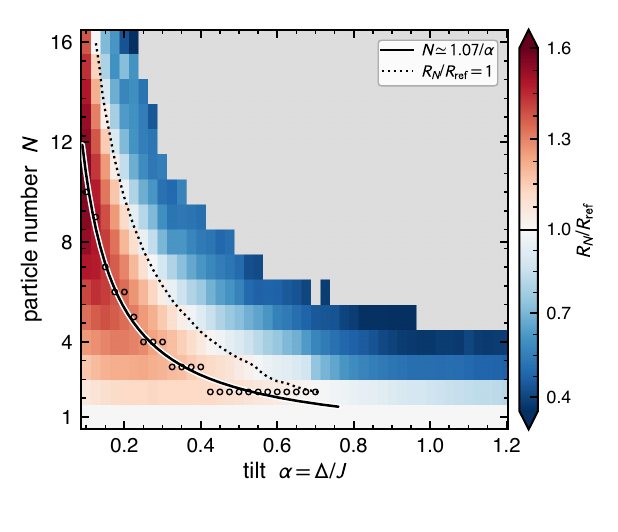 A minimal record of the leftmost particle lets one feedback action lift the whole fermion cloud, yielding a 44% work-per-information advantage before Pauli blocking sets in.
 - Deyou Chen, Lifang Li, Chuang Yang, and Kangqiao Liu
Horizon–orbit scale competition underlying chaos bound violation for spinning particles
[arXiv:2609.18143] (2026.09.16). PDF Chaos-bound violation is governed by competition between surface gravity and orbital instability: black-bounce deformation can suppress the former faster, while particle parameters shift the crossing at fixed background.
 - Kangqiao Liu
Classical codes violate the conjectured square-root bound for quantum random access codes
[arXiv:2607.15617] (2026.07.20). PDF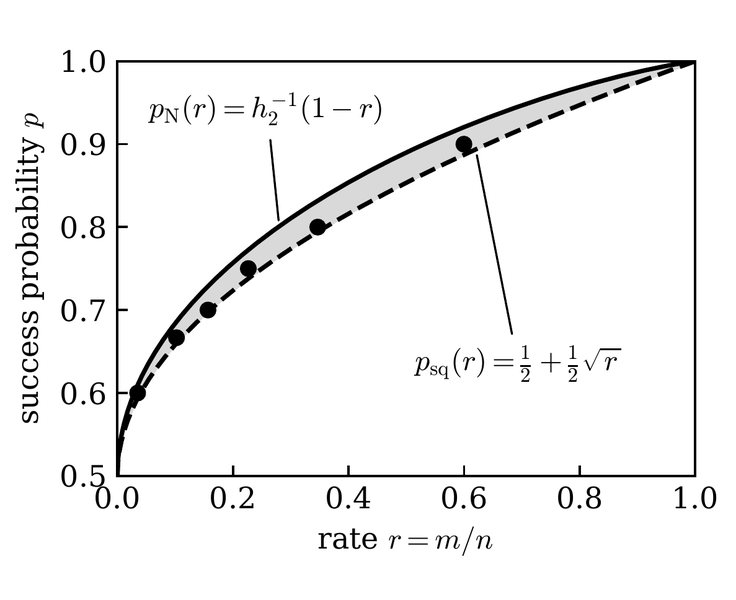 Classical random-access codes with private randomness already lie inside the unrestricted QRAC model and violate the conjectured square-root bound. The asymptotic worst-case boundary is instead set by Nayak’s entropy curve.
 - Deyou Chen, Chuang Yang, and Kangqiao Liu
Chaos bound for spinning particles in Kerr-Newman-AdS black holes
[arXiv:2607.00432] (2026.07.01). PDF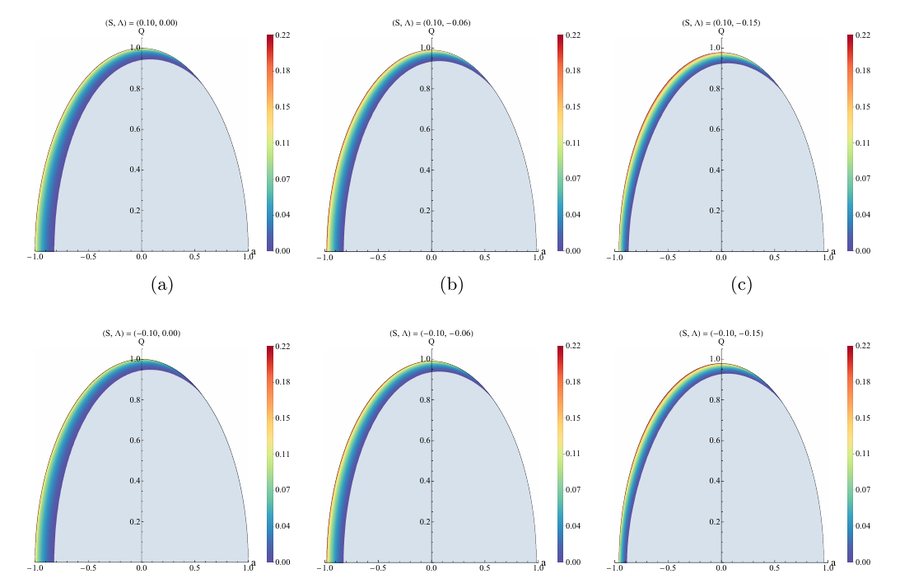 Numerical phase maps locate where the particle Lyapunov exponent exceeds the black-hole surface gravity in Kerr-Newman-AdS spacetime. Rotation direction, charge, and the cosmological constant jointly reshape the violation region.
Peer-reviewed
- Jie Gu and Kangqiao Liu
Finite-Frequency Fluctuation-Response Bounds for Open Quantum Systems
Quantum Science and Technology (2026) (Accepted Manuscript online 2026.10.02)
[arXiv:2605.03340]. PDF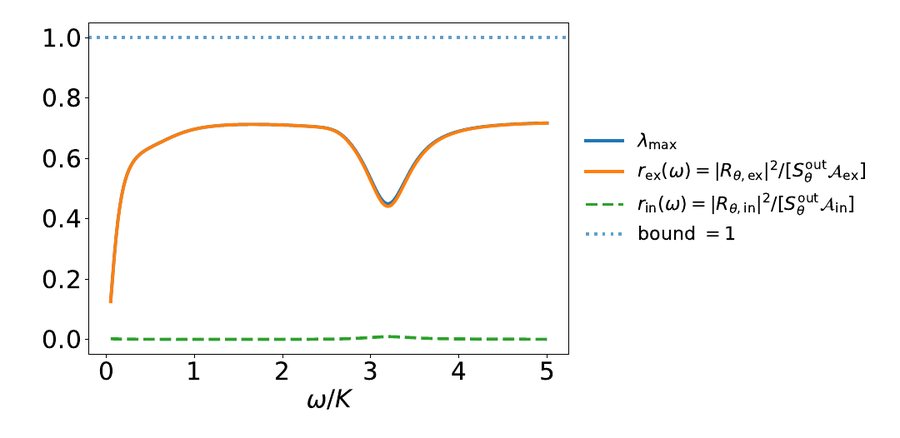 A frequency-resolved input-output inequality bounds any measured lock-in response by fluctuations in the emitted field, with a detector-independent ceiling set by quantum Fisher information and channel activity. Driven-qubit and cat-resonator examples test the bound across frequency.
 - Kangqiao Liu and Deyou Chen
Maximal-velocity deficit under a finite-support constraint in a hard-wall half-line continuous-time quantum walk
Physical Review A 114, 032434 (2026) (2026.09.15)
press release (in Chinese) by Department
[arXiv:2609.01970]. PDF code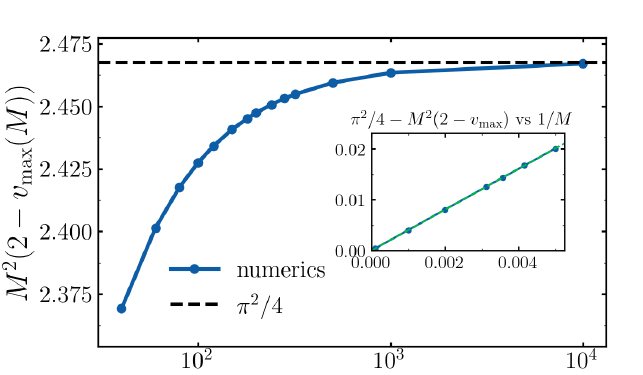 Restricting a hard-wall half-line quantum walk to initial support on the first M sites turns the best achievable ballistic drift into a principal-eigenvalue problem. The resulting velocity deficit scales as π²J/(4M²), with the coefficient emerging from a continuum Fourier-window variational problem.
 - Chuang Yang, Chuanhong Gao, Deyou Chen, and Kangqiao Liu
Bound on Lyapunov exponents with spinning particles in Kerr–Newman spacetimes
The European Physical Journal C 86, 677 (2026) (2026.06.22) PDF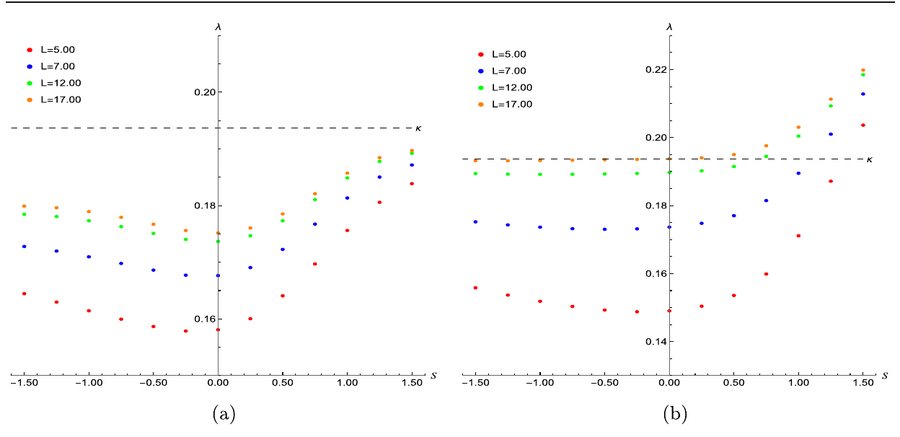 The particle Lyapunov exponent can exceed the surface-gravity scale once rotation, spin, charge, or total angular momentum crosses an orientation-dependent threshold. Counter-rotating configurations and the extremal limit expose the strongest violations.
 - Kangqiao Liu and Jie Gu
Response kinetic uncertainty relation for Markovian open quantum systems
Physical Review A 113, 062443 (2026) (2026.06.16)
press release (in Chinese) by Department
[arXiv:2501.04895]. PDF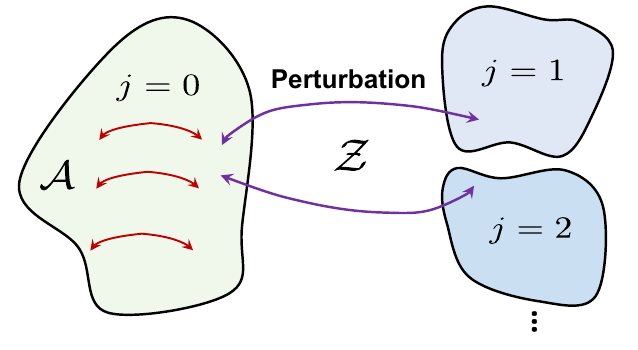 The response kinetic uncertainty relation splits the precision cost into a jump-activity contribution and an intertransition quantum term. The two pieces dominate different perturbations, yielding a unified bound for monitored Markovian quantum dynamics.
 - Kangqiao Liu, Masaya Nakagawa, and Masahito Ueda
Maxwell’s demon for quantum transport
Physical Review A 113, 022436 (2026) (2026.02.23)
press release (in Chinese) by Department
[arXiv:2303.08326]. PDF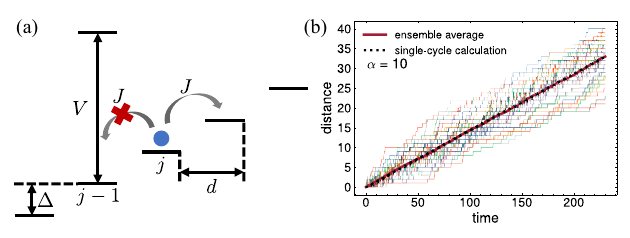 Repeated position measurements and feedback turn coherent hopping on a tilted lattice into directed uphill transport, storing potential energy without a thermal bias. The work quantifies the speed, power, efficiency, and robustness of this quantum information engine.
 - Kangqiao Liu and Jie Gu
Dynamical activity universally bounds precision of response in Markovian nonequilibrium systems
Communications Physics 8, 62 (2025) (2025.02.11)
see Behind the Paper for a blog post
press release (in Chinese) by Department
[arXiv:2410.20800]. PDF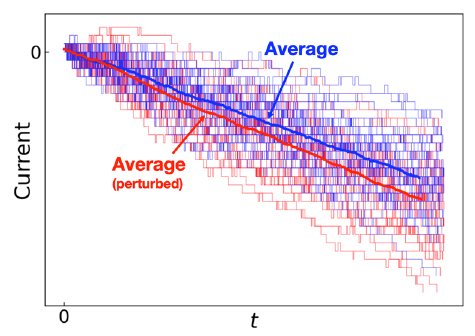 For Markovian nonequilibrium processes, response precision is universally limited by dynamical activity—the total rate of state changes—rather than dissipation alone. The bound remains valid during relaxation and can be tighter than response thermodynamic uncertainty relations.
 - Jiale Yu*, Shiyu Wang*, Kangqiao Liu, Chen Zha, Yulin Wu, Fusheng Chen, Yangsen Ye, Shaowei Li, Qingling Zhu, Shaojun Guo, Haoran Qian, He-Liang Huang, Youwei Zhao, Chong Ying, Daojin Fan, Dachao Wu, Hong Su, Hui Deng, Hao Rong, Kaili Zhang, Sirui Cao, Jin Lin, Yu Xu, Cheng Guo, Na Li, Futian Liang, Yong-Heng Huo, Chao-Yang Lu, Cheng-Zhi Peng, Kae Nemoto, W. J. Munro, Xiaobo Zhu, Jian-Wei Pan, and Ming Gong
Experimental demonstration of a Maxwell’s demon quantum battery in a superconducting NISQ processor
Physical Review A 109, 062614 (2024) (2024.06.20). PDF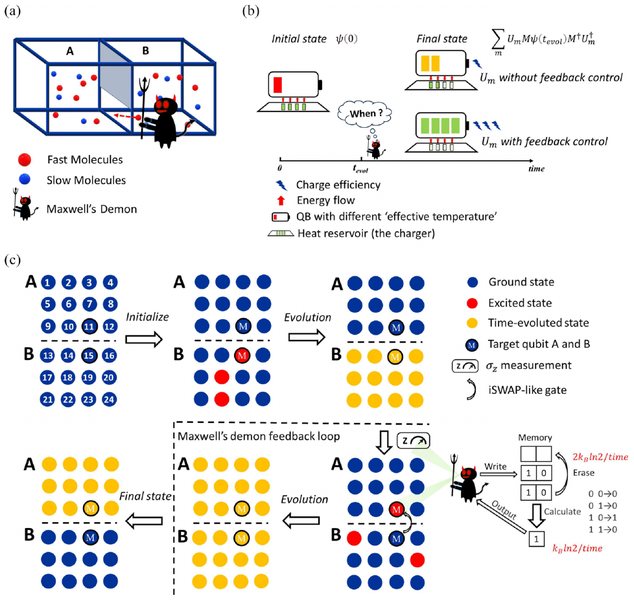 A superconducting NISQ processor implements measurement-based Maxwell-demon feedback to steer excitations from one qubit subsystem into another. The experiment demonstrates directional charging and tracks the accompanying entropy and ergodicity dynamics.
 - Takashi Mori, Liu Ziyin, Kangqiao Liu, and Masahito Ueda
Power-law escape rate of SGD
Proceedings of the 39th International Conference on Machine Learning, PMLR 162:15959-15975, 2022 (ICML 2022) (2022.07.15)
selected for Spotlight
[arXiv:2105.09557]. PDF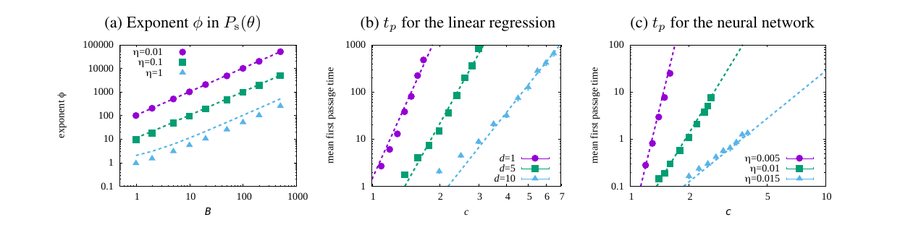 When SGD noise scales with the loss, its stationary distribution develops heavy power-law tails and escape from minima follows a power law rather than an Arrhenius exponential. Theory and neural-network experiments recover the predicted first-passage scaling.
 - Liu Ziyin*, Kangqiao Liu*, Takashi Mori, and Masahito Ueda
Strength of Minibatch Noise in SGD
The 10th International Conference on Learning Representations (ICLR 2022) (2022.01.29)
selected for Spotlight (5% of all submissions)
[arXiv:2102.05375]. PDF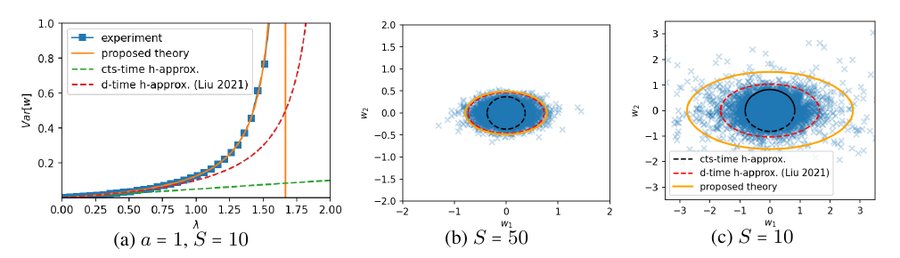 A discrete-time theory gives the minibatch-noise strength and parameter fluctuations at finite learning rate, including their divergence threshold. It explains why continuous-time approximations fail at large learning rates and predicts stability across batch size, width, and regularization.
 - Kangqiao Liu*, Liu Ziyin*, and Masahito Ueda
Noise and Fluctuation of Finite Learning Rate Stochastic Gradient Descent
Proceedings of the 38th International Conference on Machine Learning, PMLR 139:7045-7056, 2021 (ICML 2021) (2021.07.01)
[arXiv:2012.03636]. PDF Supplements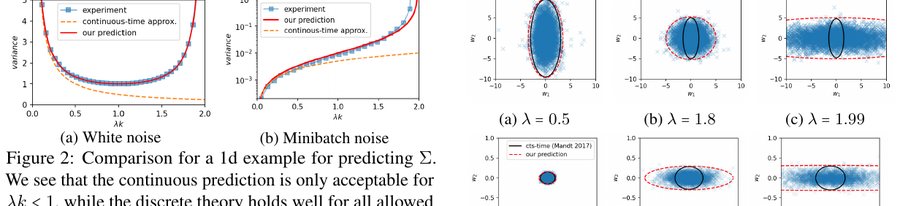 Finite learning rates make SGD intrinsically discrete: its stationary covariance, stability boundary, and escape efficiency differ from continuous-time Langevin predictions. The discrete theory remains accurate up to the edge of instability for both white and minibatch noise.
 - Kangqiao Liu, Zongping Gong, and Masahito Ueda
Thermodynamic Uncertainty Relation for Arbitrary Initial States
Physical Review Letters 125, 140602 (2020) (2020.09.29)
[arXiv:1912.11797]. PDF Supplements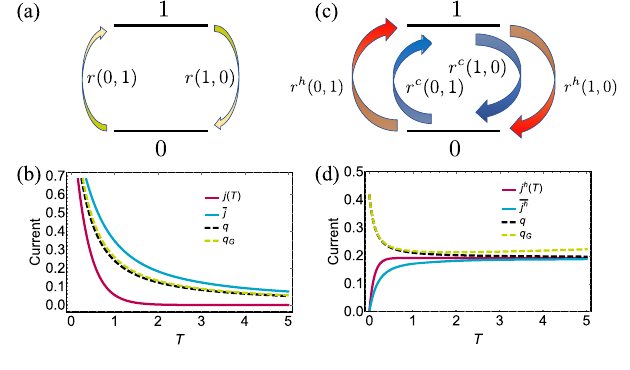 A thermodynamic uncertainty relation valid for arbitrary initial states replaces the steady-state current by the final instantaneous current. It remains valid during transient relaxation where conventional TURs can fail and extends naturally to measurement-and-feedback protocols.